Skip to content

21 Things You Need to Know About Mouth Cancer Which Could Save Someone’s Life

2015 November 2
by David

mouthawareIt’s November and at Woodcock Lane Dental Care we are pleased to be supporting  Mouth Cancer Action Month, a campaign dedicated to raising awareness of the signs and symptoms of mouth cancer and promoting the importance of early detection in ultimately saving lives. Organised by the British Dental Health Foundation, Mouth Cancer Action Month is your chance to make a difference. By knowing the facts around mouth cancer we will have the ability to stop this disease in its tracks. We have put together 21 facts you really need to know and may shock you about mouth cancer, how many do you know?

  1. In the UK, one person is told they have mouth cancer every 77 minutes.
  2. This is almost 7 thousand people every year.
  3. Mouth cancer claims more lives than testicular and cervical cancer combined.
  4. Mouth cancer takes more lives every year than road traffic accidents on Britain’s roads.
  5. Mouth cancer is diagnosed in more than twice as many men than women but there are more cases in women than ever before.
  6. Shockingly, one in ten have never heard of mouth cancer.
  7. Cases of mouth cancer have increased by a third in the last decade alone.
  8. Survival rates based on a late diagnosis are as little as 50% but chances of survival drastically increase with an early diagnosis to 90%.
  9. Scotland has more cases per capita than in England, Northern Ireland or Wales.
  10. Mouth cancer is one of very few cancers which incidences are actually predicted to increase in the future.
  11. Smoking is the leading cause of mouth cancer.
  12. But HPV is predicted to overtake it as the leading cause of mouth cancer in the next decade.
  13. HPV is predominantly transmitted through oral sex.
  14. Extending the HPV vaccine to include boys of a school age could save thousands of lives.
  15. Excessive use of alcohol is linked to more than a third of mouth cancer cases in men and a fifth in women.
  16. Heavy drinkers and smokers are up to 35 times more at risk.
  17. Mouth cancer can often be spotted in its early stages by your dentist during a thorough mouth examination.
  18. As part of every check-up a dentist is required to carry out a visual examination to look for the early signs of mouth cancer.
  19. Mouth cancer can affect anyone.
  20. Signs and symptoms of mouth cancer include: ulcers which do not heal within three weeks, red or white patches and any unusual lumps or swellings.
  21. If in doubt get checked out by your dentist or doctor as soon as possible.

With your help Mouth Cancer Action Month is the perfect opportunity to fight back against mouth cancer, we want everyone to be Mouthaware and be on the lookout for the signs and symptoms of mouth cancer.

Share these facts to spread awareness of mouth cancer to everyone and ensure we are all together in combating mouth cancer.


Bruxism – Causes, Symptoms and Treatments for Tooth Grinding

2015 July 28
by David

Bruxism is a medical term to describe teeth grinding. In a little more detail it covers a range of actions that involve the teeth, the jaw the muscles of the jaw and the temperomandibular joint ( TMJ ).
The symptoms can range from a mild disturbance to pain so severe that patients can not sleep or work.

are you grinding your teeth

It can effect children and adults but main age range is 25-45.

Two main types..

Daytime or awake Bruxism..this usually involves just a clenching of the jaw in response to a stimuli .
Asleep bruxism occurs when one is asleep and often involves jaw clenching combined with a grinding of the teeth and contraction of the jaw muscles . Usually there is an associated noise as the teeth move over each other.

What are the causes ?

Bruxism has a multitude of causes and it can be difficult to highlight one as the main cause, however a few of the causes discussed are:

  1. Incorrect tooth alignment. If your teeth are not in the correct position then it can lead to the teeth meeting in a different position. This leads to the muscles attached to the jaw being stretched in a way they are not comfortable and this can lead to muscular pains such as head and neck ache. The teeth receive a message from the brain indicating the discrepancy in the bite and try to grind their way to a more comfortable position. This in turn leads to more symptoms, and so in turn leads to more pain. The best way to correct this is to move the teeth back in to a correct position, from something as simple as a minor filing of the tops of the teeth ( occlusal equilibration) or to Orthodontics ( braces). The orthodontic process is usually reserved for extreme cases.
  2. Stress. Just like mouth ulcers, cold sores and stomach ulcers all increase propensity with onset of stress. So does the occurrence of bruxism, as a result the best way to treat this cause would be to find ways to de-stress. The largest cause of bruxism is stress related. Exercise and life changes to encourage a more relaxed environment would help …though not always possible !
  3. other conditions…there is a strong link to Obstructive Sleep Apnea and patients who suffer from this also get episodes of bruxism in the night.
  4. Stimulants ….regular users of alcohol, drugs, tobacco and caffeine ( more than 6 cups a day)….all of these stimuli can cause disturbed sleep which can result in increased occurrence of bruxism.

What are the symptoms ?

They are wide ranging but main ones are
• Soreness from muscles of the head and neck
• More sensitive teeth, if they begin to wear down
• Clicking or popping noises from the jaw joint
• Lock jaw when jaw is opened wide
• Headaches, neckaches and shoulder pains
• Limited opening of the jaw
• Earaches

What are the treatments?

There is wide debate in the dental community as to what is the best treatment. The truth is that the most important part is that the patient is seen by the dentist and a thorough history is taken. This allows the dentist to identify most obvious reasons for this bruxism and the extent it impinges on the patients life.

Models and photographs of the teeth should be taken, as well as listening to any noises of the jaw joint. A simple night time splint can be worn to take the load off the joint and also balance the way the two jaws meet. This is called an Occlusal splint and has the effect of reducing the load on the muscles. A splint is a laboratory constructed plastic that is hardened and designed bespoke to each patient to accommodate and reduce the effects of grinding. It can be quite dramatic how much it can improve and how quickly this is noticed.

Additional treatments could include anti stress medication, orthodontics to move the teeth and lifestyle changes.

Circus Time

2015 June 17
by David

We at Woodcock Lane Dental Care are proud to support Circus Starr – the circus with a purpose.

We are delighted to have been able to support our local Stroud and Stonehouse community by buying and donating tickets for disadvantaged and disabled children and their families to go this fantastic event that was held in a big top at Cheltenham Racecourse at the weekend.

Circus certificateCircus Starr is a touring circus boasting world-class, professional artists from across the globe. It was first founded in 1987 to help raise much needed funds for local charities whilst providing free seats for thousands of disadvantaged, disabled or vulnerable children.  


National Smile Month

2015 May 20
by David

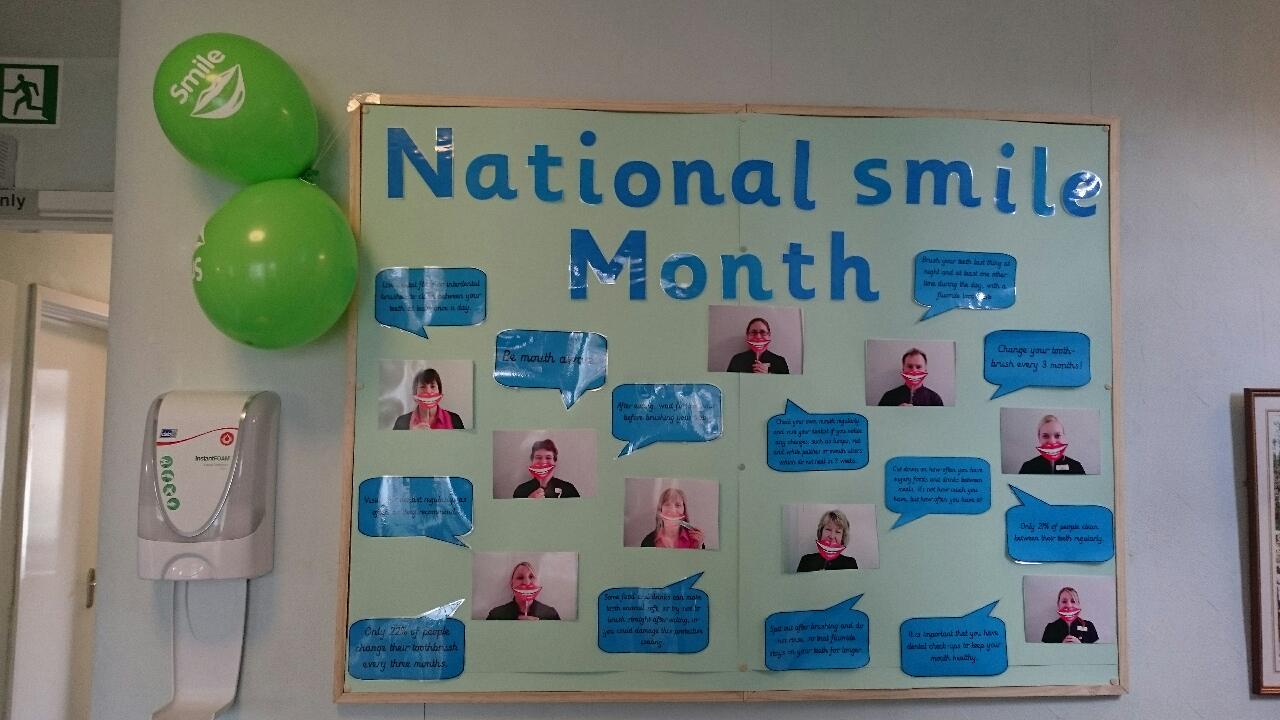
All of us at Woodcock Lane Dental Care are getting behind the UK’s largest and longest-running oral health campaign this month in a bid to raise awareness of the importance of good oral health. DSC_0051

National Smile Month was established in 1977 and is the UK’s biggest annual oral health campaign. The campaign is sponsored by headline sponsors Invisalign, Wrigleys and Oral-B. The campaign, which runs from 18 May to 18 June 2015, is also being supported by Denplan, the UK’s leading dental payment plan specialist. The campaign promotes three key messages for great oral health:

  • Brush your teeth last thing at night and on at least one other occasion that day with a fluoride toothpaste
  • Cut down on how often you have sugary foods and drinks
  • Visit your dentist regularly, as often as they recommend

If you would like to improve your smile, we would be delighted to help you. Jackie, our hygienist, is able to look after the health of your gums and polish your teeth. David Lyons and Frank Moran, our dentists, are able to provide not only routine dental care but also cosmetic treatments such as tooth coloured fillings, veneers and crowns and tooth whitening. David is also able to offer tooth straightening and  James MacDonald, our visiting dental implant dentist is able to offer dental implants.


If you are interested in any of our services, our friendly reception team are on hand to answer any queries or questions on 01453 828327.


Happy smiling 🙂


No Smoking Day

2015 March 2
by David

This year Wednesday 11th March marks the British Heart Foundation’s No Smoking Day.

no_smoking

At Woodcock Lane Dental Care we are supporting one of the country’s biggest health awareness campaigns, designed to encourage current smokers to quit by providing readily available support and advice.

Most people know that smoking has been linked to causing heart disease and cancer but not as many people realise the degree to which smoking affects their oral health too. Here’s a list of known problems smokers encounter:

  • Bad breath
  • Tooth discolouration
  • Increased build-up of plaque and tartar on the teeth
  • Increased risk of developing gum disease
  • Delayed healing process following tooth extraction, periodontal disease, or oral surgery
  • Lower success rate of dental implant procedures
  • Increased risk of developing oral cancer

No Smoking Day presents us with an opportunity to explain how stopping smoking can benefit the person. Within the first month of giving up an ex-smoker will begin to experience the following:

  • Improved sense of smell
  • Improved sense of taste
  • More energy
  • Whiter teeth
  • Better breathing
  • Fresher breath
  • Younger looking skin
  • Healthier sex life
  • Lowered stress levels
  • Saving money

Regular visits to your dental team are essential to look after your teeth and gums, and even more so if you’re a smoker. Your dentist is best-placed to help you combat the effects of smoking, and to spot any other conditions that may need further investigation.

No Smoking Day will hopefully help to raise awareness across the UK that if you are a smoker and you would like to quit this year, March 11th would be a good time to try as you won’t be alone

To find out more about No Smoking Day and for help and advice on kicking the habit, visit the official campaign website. https://nosmokingday.org.uk/

Three Tips to Take into 2015

2015 January 20
by Liz

It is estimated that half of people in the UK will make a New Year’s resolution. Diets, smoking and general fitness top the most common resolutions, but at Woodcock Lane we believe teeth should be a priority.

Woman brushing her teethPeople who make a resolution to adopt a good oral health routine in 2015 will benefit from more than just improved oral health. Adopting good oral health can contribute to avoiding potentially serious health conditions such as diabetes, strokes and heart disease.

Research shows that only one in two people are happy with their teeth, with tooth loss and stained or yellow teeth of concern to many.

Healthy smiles are also important to many other facets of life. Having the confidence to smile shapes our image and is hugely important to relationships. When it comes to attraction, surveys have shown that a smile is even more important than the face, eyes, dress sense, body shape, hair and height.

To help you get the New Year off on the right foot, here are  three top tips for looking after your teeth in 2015.


1. Don’t rinse after brushing

“So many people rinse their mouth out with water or a mouthwash after they have brushed their teeth”, says David Lyons, dentist here at Woodcock Lane. “Doing this means you won’t get the benefit of the fluoride in toothpaste or the mouthwash. We advise people to spit not rinse. If you do want to use a mouthwash, use it at a different time of day, perhaps lunchtime.”


2. Know the links

You may not think it, but oral health has been linked to a number of life-threatening illnesses such as  Pneumonia, heart and circulations problems, pregnancy complications and male sexual health problems. All of these have been linked to poor levels of oral health. Next time you skip brushing your teeth, think about the problems you could encounter.”


3. Size matters

Woodcock Lane Dental Care hygienist, Jackie says “Make sure your toothbrush is the correct size for your mouth and the filaments are soft/medium. Cheaper toothbrushes may have filaments that are of poor quality so may not be as effective as branded versions. If you can, buy the best toothbrush you can afford and change it on a regular basis, preferably every three months.”


Mouth Cancer Prevention

2014 November 24
by David


Mouth cancer is one of the top ten most commonly diagnosed cancers and accounts for more than 7,800 new cases a year. Over the past 10 years the incidence of mouth cancer has risen by 25%. The early signs of mouth cancer can often be seen and when it is found early there is a better chance of surviving it.


MOUTH CANCER – KNOW THE SIGNS:-

  • an ulcer or sore in your mouth that lasts longer than three weeks
  • persistent discomfort or pain in the mouth
  • a red or white patch in your mouth that lasts longer than three weeks
  • an unexplained lump in your mouth or neck
  • a sore or painful throat lasting more than three weeks
  • a long-lasting croaky voice or difficulty swallowing
  • numbness of your tongue or mouth
  • neck swelling that lasts more than 3 weeks


Lumps and ulcers in the mouth are very common and usually get better on their own. Changes that last longer than three weeks could be serious and should be reported to your doctor or dentist without delay. It probably won’t be mouth cancer, but if it is, detecting it early gives a better chance of successful treatment.

HOW TO REDUCE YOUR RISK:-


  • be a non-smoker – smokers are more than three times more likely to develop mouth cancer than non-smokers


  • avoid chewing tobacco or betel nut quids


  • cut down on alcohol – the more you cut down on alcohol, the more you reduce the risk of mouth cancer. People who use tobacco and alcohol have the highest risk of mouth cancer.


  • visit your dentist regularly:- a mouth cancer check is part of your dental examination


 Visit your dentist or doctor at once if you notice any abnormal

 problems or are not sure.                                                          

“If in Doubt, Get Checked out” – November is Mouth Cancer Action Month

2014 November 12
by David

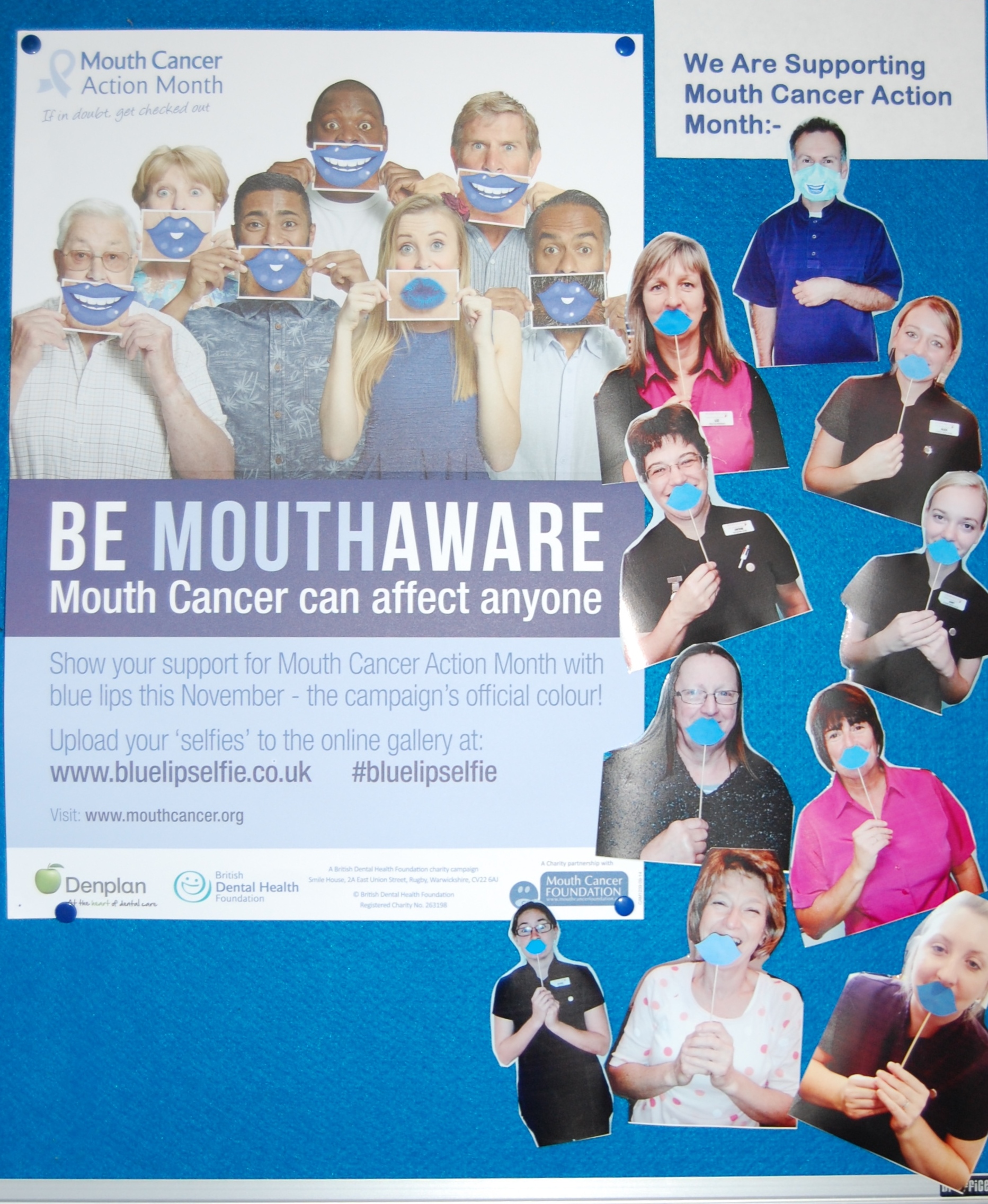
We, at Woodcock Lane, are proud to be supporting  Mouth Cancer Action Month 2014. Organised by the British Dental Health Foundation, it promotes the message “if in doubt , get checked out” in a bid to save thousands of lives through early detection. We are excited to share with you our “blue lip selfies” as a visible sign of our support –  #bluelipselfiesMouth Cancer 2014 - Blue Lips 2 (2)

David Lyons, principal dentist at Woodcock Lane Dental Care, says “mouth cancer can often be spotted in its early stages by a dentist during a mouth examination and, if caught early, there is a 90 per cent chance of survival”.

Mouth cancer checks are carried out routinely on every patient that attends the practice,  at their examination appointment. During the month of November we would like to offer these checks to anyone in the local community. Anyone is welcome to make a FREE of charge appointment for the mouth cancer screen. Simply telephone 01453 828327 and our friendly reception team will be delighted to arrange a suitable appointment.


Think Before You Drink

2014 October 22
by David

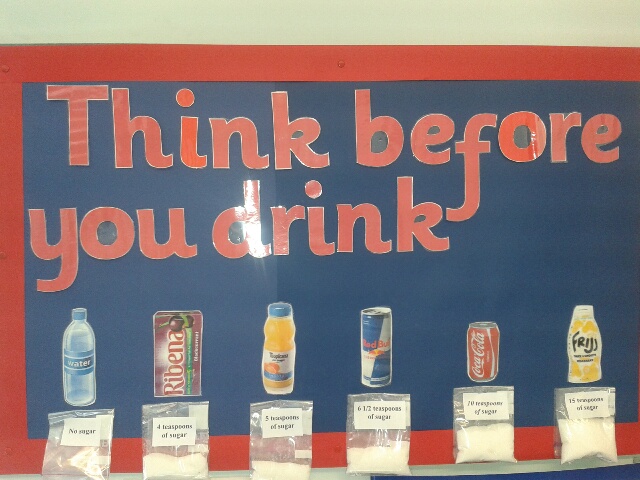
20140909_131147_resized_2Stay hydrated the healthy way

Our bodies are made up of 70% water and we regularly hear about the importance of staying hydrated.

It’s essential for concentration, energy levels, healthy skin and our overall wellbeing, but did you know that it’s also vital for good oral health?

Saliva protects against tooth decay and because one of the symptoms of dehydration is a dry mouth, maintaining a good level of hydration will keep your saliva levels stable and help to keep on top of good oral health.

Drinking the right things to keep us hydrated and our teeth healthy is also essential. You probably know that regularly sipping fizzy drinks can cause significant damage to teeth, but there may be other seemingly ‘healthy’ drinks that could be harming your teeth…

Smoothies

Many supermarket smoothies contain up to 10 teaspoons of sugar per 250ml serving, which is actually higher than full-sugar cola! Although they contain vitamins and count towards your ‘five-a-day’, enjoy smoothies in moderation as they contain high levels of acids and fructose – a natural sugar found in fruit. Their sticky consistency also means that they cling to teeth, so try to avoid drinking them between meals.

Fruit juices 

Like smoothies, fruit juices contain powerful acids and high levels of natural sugar that can cause tooth decay and damage tooth enamel, so they’re are best kept for mealtimes only. Always dilute fruit juice when giving it to children (one part juice to one part water).

Sports drinks

Keeping hydrated during exercise is very important, but think twice before reaching for a bottle of sports drink. They are notorious for the high quantities of sugar and acid they contain and can damage your teeth in the same way that a regular fizzy drink would.

Our mouths are also more vulnerable during exercise as we tend to have a drier mouth and produce less saliva, leaving us even more susceptible to decay. Instead of sports drinks, look for low-sugar options or stick to water during exercise which is 100% tooth-friendly and will keep you fresh and hydrated.

Do I Need a Filling?

2014 October 15
by Liz

You cannot see much in your mouth but how do you tell if you need a filling? The obvious answer is to visit your dentist. Our dentists at Woodcock Lane Dental Care have special lights, sensors and x-ray devices that can see inside all your teeth to check they are healthy. The latest x-rays are digital with only 10% of the radiation of some previous ones.

The common symptoms that you may notice if you need a filling:

1. Discomfort on biting.

2. Sensitivity with temperature. It can be with hot, cold or even sweet drinks and foods. The longer the discomfort lasts after having the food or drink, the closer the decay is to the nerve of your tooth.

3. Food getting caught in between teeth. Often it can be hard to remove with floss or sticks and is due to a hole in a tooth.

4. A rough or sharp tooth, often more noticeable with your tongue rather than your finger.

5. Your dental floss tearing on a particular area/teeth in your mouth.

6. Toothache. A general ache in an area. Often it is hard to work out whether it is coming from your top or bottom teeth, let alone which particular tooth!


You may see:

1. Some discolouration in a tooth. This can be white, a cream colour, orange or yellow or just a dark shadow.

2. A crack. Early decay gives NO symptoms and can be reversed before you need a more complex or expensive procedure. Fluoride may be applied or a sealant applied to the tooth.

Decay is not the only reason you may need a filling. Your tooth may be cracked or worn from nail-biting, tooth grinding (bruxism) or using your teeth to open things. Worn teeth can be built up with tooth-coloured filling materials.

At Woodcock Lane we believe in prevention and help you reverse the signs of dental disease. If you think you need a filling we can assess your mouth and discuss all the different materials that are currently available and what would be best for you. Let the experts make sure your mouth is cavity free by calling 01453 828327 where our friendly reception team will book you in for your initial assessment